
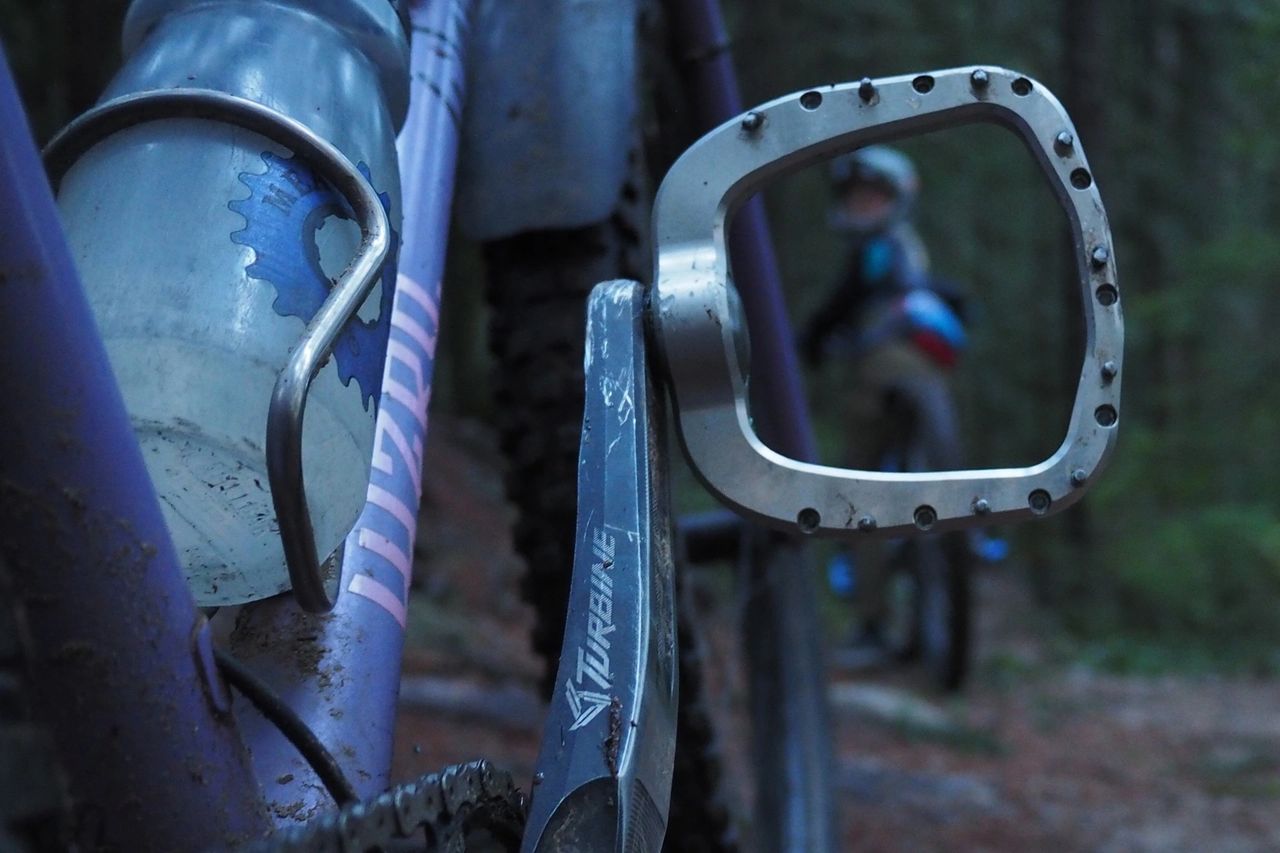
I have endless thoughts about Outlier, their newly released Void pedals, and their pending Pendulum pedals, but the best place to start is probably in the abyss. That is to say, the big hole in the middle. It is the obvious omission of a standard pedal axle that makes these platforms comment magnets on the trail. And, to the obvious skepticism of most riders who ask, it truly is a case of less being more.
The traction on both models is fantastic, but the one truly defining feature I would highlight for Outlier’s platforms is comfort. I noticed the difference right away, especially descending higher speed janky trails on my hardtails, that no matter what pair of shoes I was using my feet were happier at the bottom. I go back and forth with other pedals regularly and it’s consistently a benefit.
These Calgary, AB-designed, and Calgary, AB-manufactured pedals have a lot going on for how few pieces make up the final product. Two 7075 aluminum bodies, pins, two short steel axles, four oil-filled 6902 bearings, two washers, and two preload caps/shields. And I’m going to cover all that in way too many words below.
So, if you’d like to jump to the Outlier Website and come back to the exposition expedition later I completely understand. For everyone else, welcome to:
Outlier Pedals – The Void & The Pendulum – A Many-Months Review of Sorts & A Teardown, If I Can Call It That.


Housekeeping
Below you’ll find a section dedicated to the two-sided Void pedals, which are available now, and a separate section on the one-sided Pendulum pedals, which are a near-future release. Both pedal designs make me smile, and I have mostly positive things to say, so I thought I’d start by getting the potential negatives out of the way first.
1) These are large platforms and are not recommended for shoes smaller than a size 7 men’s or size 8.5 women’s.
2) A housing big enough for a pair of inboard 6902 bearings does enhance a bike’s stance. It works great for me, but folks who are already struggling a bit with the wider Q-factors of SRAM and Shimano’s latest cranks may find their feet moved too far outboard.
3) Pedal bearings are preloaded by being tightened into the cranks (30NM). If you’re that person whose pedals regularly come loose on rides because you never bolt-check your bike, maybe give these a pass.


A Story,
I should probably just add a disclaimer to everything I write about salting the obvious biases in all my reviews to taste. I mean, I typically only write about products and people that I like so just imagine a giant neon ‘Caution: Biased’ sign in the header. This is no exception as one-half of Outlier Pedals is my friend Cameron Belisle O’Donnell, who is also behind the internal temperature-raising TonTon fat bike – also designed and manufactured in Calgary, AB – and The Inside Line bike shop.
The Clairebarian and I sat down for a United Strangers coffee with Cameron last year to discuss testing the one-sided Pendulum pedals here in North Van. Possibly the worst place for a one-sided pedal that drops the platform 12mm below the pedal axle. Especially for a rider mulleting already-low 29’er hardtails and riding steep janky trails. Cam’s fearless about this stuff. If they don’t work, they don’t work. It’s a thought experiment first, albeit an expensive one, and from day dot these were not intended to be products that would work for everyone everywhere.
I took delivery of the Pendulum Pedals in February, ’24, and the Void Pedals in March, ’24 and I put the miles on each of them while also jumping back to my favourite control pedals – the NSBillet Daemon and Wolf Tooth Waveform – and finding time to ride a few other pedal options as well.

Guts
One significant difference between the Outlier Pedals and any other system I’ve tried – flat or clip-in – is they don’t, in my experience, develop slop or play. Instead, the wear cycle is more like a bottom bracket where the bearings simply become rougher and rougher and eventually they don’t spin nicely enough. Then it’s time to swap a couple of easily replaced bearings into each body. It actually takes me as long to dig out the tools as to remove the pedals and do the swaps.
The process is simple. Remove the pedals from the bike. Push through the short stainless steel axles – a little persuasion with a plastic or hard rubber mallet, if necessary, never hurt anyone – and then you’re essentially changing the bearings in any suspension linkage. The only tools required are the hex key to remove and install the pedals, your preferred bearing removal method, and a bearing press.
Outlier has spent a lot of time playing with different bearing setups and solutions and the oil-filled bearings I’m riding in the Void pedals now are the production choice. I don’t have a ton of hours on these but I’ll report back on what the bearing life is like. They are beyond smooth though, DuraAce-road-pedals smooth even.
I have not ridden the final production Pendulum pedal guts, but I’ll hopefully be going over those as part of a review update when the Pendulum comes to market.


The Void Pedals
The 115mm x 115mm platform of the Void pedals is under 10mm thick (9.85mm thin if you’re one of those precise numbers people). By moving the guts inboard there’s no internal durability trade-off from having a pedal so thin while the outboard clearance advantages are obvious.
The absence of a center axle through the pedal ‘void’ combines with a little bit of shoe flex to make them, as noted, the most comfortable pedals I’ve used (size 43 shoes) but also to make them the most concave-feeling pedals I’ve ridden. Even though the Void pedal is two-sided it’s still the most in-the-pedal experience I’ve had other than the Pendulum.
Each pedal weighs 229 grams. This is bizarre in that the claimed weights for both the Void and Pendulum pedals actually match my scale. The pedals have 9 pins per side and seem to be fairly shoe-agnostic. That’s not to say that my stickiest Giro Tack rubber shoes don’t grip better than my firmest Bontrager Vibram rubber soles, but any shoes I have are entirely rideable until conditions get particularly greasy or trails get particularly janky.
My favourite shoe combination for either Outlier is the Shimano GF600 (GF6) with its slightly stiffer construction and quite-sticky, long-lasting, sole.

With more comfort, less trail contact, great grip (and the wider stance being the only concern of note for some folks), the Void is an easy pedal to love. I don’t know that anyone will be dumping a perfectly good pair of top-end pedals to buy them, but come replacement time this would be my first choice for my Waltworks. Combined with the wider Shimano Boost axle on the Arcturian the Outlier pedals do add a little bit of a fat bike stance effect which I actually like descending but which takes some getting used to each time swap them in, specifically when I’m climbing.
They are not inexpensive pedals, but between performance, ease of service, country of origin, and quality of manufacturing I think the price is comparatively fair. They have also been bombproof. I’ll, of course, update in the future but with extra bearings and pedal pins I’m thinking this will be a long-long-long term review process.

The Pendulum Pedals
If the two-sided Void is a meticulously made, high-grip, big-and-thin flat pedal with the distinction of a notable comfort bump descending, then the one-sided Pendulum is all that with a side of improved balance thanks to the 12mm drop relative to the axle. There’s extra-improved grip via the tiny 3mm pins (pin durability isn’t an issue when you are not rocking them into, well, rocks). The lowered foot position encourages their rider to drop their heels in aggressively technical situations for better traction.
Some riders may want shorter crank arms but I went ahead with my preferred 175mm arms with no complaints (though I do have to adjust my saddle height a fair bit). With no pins on the bottoms, the Pendulum pedals slide over trail protrusions much better than any pedals I have ridden. They are not small bodies, 120mm x 115mm, but even dangled I hit them surprisingly rarely and they slide beautifully on most surfaces.
These pedals are so fun cornering and ripping down flow trails but I have had a few spicy moments on technical trails where I ended up putting my foot on the pin-less bottom portion after a dab (the pedal came to rest upside down). This is simply because I do not yet have the super-smooth production guts, and the final product will be self-righting.


*{Above photos: Steve & Meg @Hardtail.Life}
I have struggled quite a bit on how to say this without it sounding like I’m ripping on the Pendulum pedals. I’m not, I enjoy them on the trails. For mountain biking here on the North Shore I would choose the Void for myself; however, there are plenty of trail networks where the one-sided Pendulum would be my first choice, out of any pedal, unquestionably. The foot position below the axle is so much fun.
That said, I also want to note that Outlier has gone and produced my perfect flat pedal for groad and ATB usage. The Pendulums positively made Steve’s Talbot, which I ruined, come alive. It rails turns – RAILS – and climbing foot-traction is as close to a clip-in pedal as you’ll ever get without buying shoes and actually locking into the bike. I installed these as a last-ditch decision to avoid sourcing a smaller 144 BCD chainring or going back to clipping-in, as the 45x18t gearing I chose was feeling maniacally massive for the local hills.
One short ride and I’ve never looked back. Luckily the Talbot sits for the winter months, so I’ll be able to get some more Pendulum testing in on my mountain bikes. Oh, and with only sporting pins on one side, even with the massive platform these are only 207 grams per pedal.


The Future
I don’t have any read on how Cameron & co-owner Peter will do with their Outlier pedals. The one-sided Pendulum pedals are a unique product in the market not just in their appearance but in the very real ways they change how a bike rides. They won’t be for everyone and every trail network, but are they good kind of weird that folks will want to try?
On the other hand, the Void pedals are your typical double-sided orientation with some very real advantages in bearing performance, ease of service, and the neat added comfort factor for those of us who get hot feet on long descents. Is the void in the Void still too weird for the average rider? I will note that in my years testing bicycle things I’ve never had so many friends ask if maybe they could try something at some point, or as many fellow travelers ask about anything product in general.
Beyond the design and any assessment of aesthetics and potential benefits, there is the price. These pedals and axles are machined in Canada and went through an extensive design and testing process and that’s reflected in the price of CA$299 (About US$215 today). On the one hand, that’s a lot of scratch. On the other hand, plenty of the top-end mass-manufactured pedals are over two bills now and aren’t nearly as nicely made or resilient. And, as a comparison, in Canada, my excellent quality Wolf Tooth Components Waveform pedals are now over three hundred dollars.
True, other pedals are available in colours other than black and raw if that’s a primary consideration.

I could type all day, but I’m going to leave things here for now. With the shop cat out of the bag, you’ll be seeing a lot more of these pedals on MEATengines as I continue with the review process. How long will the oil-filled Void bearings last? How much will the final Pendulum vary from what I’m riding now? I’m also excited to see what unique takes Outlier has on other mountain bike products.
Any questions pertinent to this review (or otherwise) you know where to reach me. Other than that, here are the links to the Outlier Void pedals and Outlier Pendulum pedals. Enjoy.
Welcome to MEATengines, I hope you enjoyed this piece. If you did, please consider buying me a coffee. Any questions, concerns, or comments – or to order a MEATengines water bottle – feel encouraged to drop me an e-mail, or join us at r/MEATengines.