
(Embargo Sept, 25th || All Photos Provided By Cycles Devinci)
It’s September 18th and I’m writing my first-ever embargoed piece for MEATengines. It will go live on Sept, 25th (good morning) and feature two fresh Canadian-made metal bikes from Devinci. The 2025 Troy and Troy Short Travel (ST). They feature Devinci’s unostentatious internal cable routing* – second only on my preference list to good, clean, external routing – an external bottom bracket, split pivot suspension with a non-idler setup ideal for efficiency-forward trail bikes, and industry almost-standard Boost 148 rear spacing.
*{Drewitors note: Devinci even calls out the fact their cable routing doesn’t take the touristy route through the upper headset bearing. More mountain bike brands are listening than are not.}
And I know what you are probably thinking here. How am I still on any active media list?! Who the… knows? Certainly not me. More importantly, perhaps, from where I sit, is that this space, MEATengines, isn’t exactly a press-release sharing platform. There’s no skid row bro going on, no advertising, and no test bike headed my way (not even Matt Beer’s second-hand one) so what’s up?


I’m already a fan* of Devinci’s split pivot bikes (whether the long-travel HP+I versions or the shorter-travel cleaner & simpler versions that forgo the idler pulley) and let’s be honest, bikes haven’t changed a whole heck of a lot over the last five years whether we’re talking spec or geometry. Sure, the only builds released so far have T-Type drivetrains and mullet (MX) options abound, but almost no one is still pretending they are reinventing the wheel with every new product launch.
*{Drewitors Note: Andrew does not work in a bike shop that sells Devinci and does not otherwise have an industry relationship with the brand.}


But what is a big deal here is that Devinci has not designed their fresh frames around a 157x12mm Super Boost rear axle spacing for the sake of doing so. Using what amounts to the DH standard might make sense in packaging the suspension of the HP+I Chainsaw Super-Enduro rig and the pending return of the World-Cup-ready Wilson DH bike, but for the Troy and Troy ST there is no advantage to the heavier and more proud setup unless you’re a company selling derailleurs (or replaceable derailleur cages).
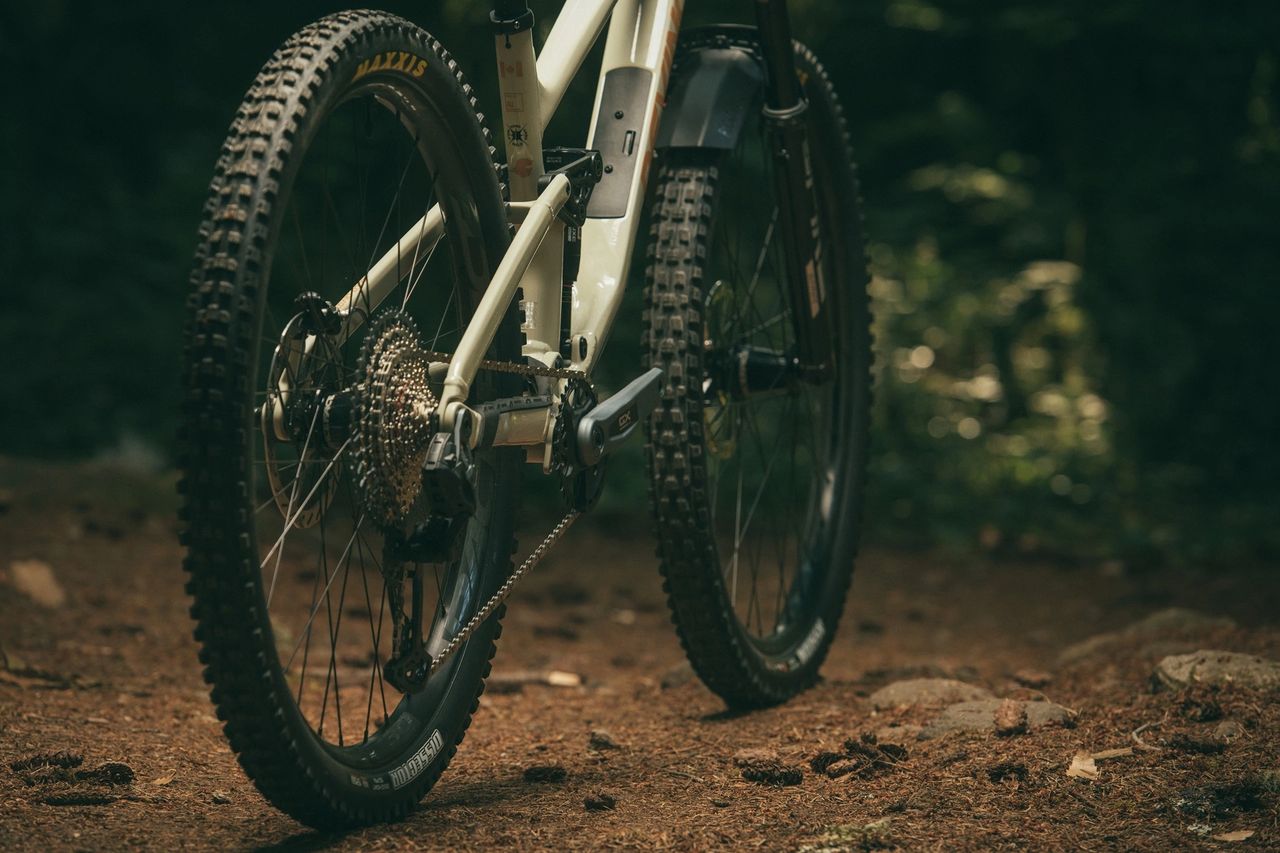
Boost 148×12 wheels are plenty stiff to the point that wheel brands are chasing more compliance. Devinci’s split pivot frames are plenty stiff with large bearings and solid interfaces. The new Troy frames deliver plenty of tire and chainring clearance with rear-centers that are 432 or 435mm on the small and medium (flip-chip dependent) and 442 or 445mm on the large and XL.


There are also more choices in the hub and wheel market – new or used – and for those that look at stiffness as a system, an easier time building the perfect trail bike setup. Plenty of tire clearance to boot, what’s not to like? Okay, yes, especially once T-Type goes to 13-speed there’s a chainline argument to be made for SB-157 rear spacing but as long as folks choose a chainring size that lets them use the last 1-2 gears as bailout last-options for brutally long days or heinously steep sections it’s all good.
On that note – see the photo above – the ample chainring clearance probably means that downsizing the ring can also include moving the chainring inboard for better chainline in the highest torque gears. Maybe that’s not easy enough with the fairly constricted T-Type setups, designed for the pending jump to 13-speed, but presumably, there are a range of more min-maxed spec options coming.
I would love to see a Deore M5130 LinkGlide build with RockShox Select+ suspension, Code Silver Stealth brakes, a dropper post that’s not made by SDG, and wheels that don’t scream “REPLACE ME!” The SRAM GX builds that were just released use RaceFace Vault J-bend hubs and I would definitely be happy to run those on the above min-maxed build.


Thanks to a geometry-saving flippy-chippy, the Troy and Troy ST are both mullet or 29″ capable (and technically dual 27″ capable when combined with a significant over-forking?! Just saying!) but their OE setup choices speak to where I think most shared platforms will go.
The standard Troy comes stock as a mullet (MX) build, with a 27″ wheel rear and 29″ wheel front, and 150mm travel. The 130mm travel Troy ST uses dual 29″ wheels except for the smallest two sizes (XS and Small) where dual 27″ wheels are to be found. One more interesting note here is that the short travel version covers five sizes whereas the longer travel model only has four. That is, the longer travel version drops the XS option.
I am always surprised that Devinici does not use their in-house manufacturing to offer a more significant range of sizes. For example reaches on the Troy ST range from 423mm to 508mm, in the low geometry setting so there’s about 20mm between sizes. The addition of a XXL and maybe even a medium-large, or large-medium, and spreading out those numbers would optimize fit around plenty more riders.


The new Troy and Troy ST are going to be awesome for a bunch of reasons. Not the least of which is that the old Troy (and the Troy before that) were awesome, and this rig is a refinement rather than a departure—unless you really, really want downtube storage*. In that case, I suppose it’s a revelation.
*{Drewitors note: Toucan and I haven’t patented it yet, but we recently invented the clear downtube storage door so you can see what’s rotting in there at all times.}
Made here in Canada with an evolved suspension design that works fantastically with budget-friendlier (read more basic) rear shocks. Easy to work on. And well-supported, I was going to say ‘honestly supported’ after the fact. Definitely, a bike I would consider owning if I was in the market for a full suspension rig.
But what gets it mentioned here is seeing the brand choosing function over marketing on one of its highest-end bicycles – fans would be correct in noting that the Marshall had already moved to 148 to take advantage of hub availability in that size. It’s always a win when brands can make their bikes better by making choices contrary to their past marketing. Specialized ditching PF30 and proprietary shock mounting, any number of brands returning to BSA bottom brackets, and here Devinci choosing 148×12 spacing for their excellent trail bikes.
And, since we’re press-releasing it up, today. Here’s a link to the bikes. Note that there are more builds coming this spring.
Welcome to MEATengines, I hope you enjoyed this piece. If you did, please consider buying me a coffee. Any questions, concerns, or comments – or to order a MEATengines water bottle – feel encouraged to drop me an e-mail, or join us at r/MEATengines.