
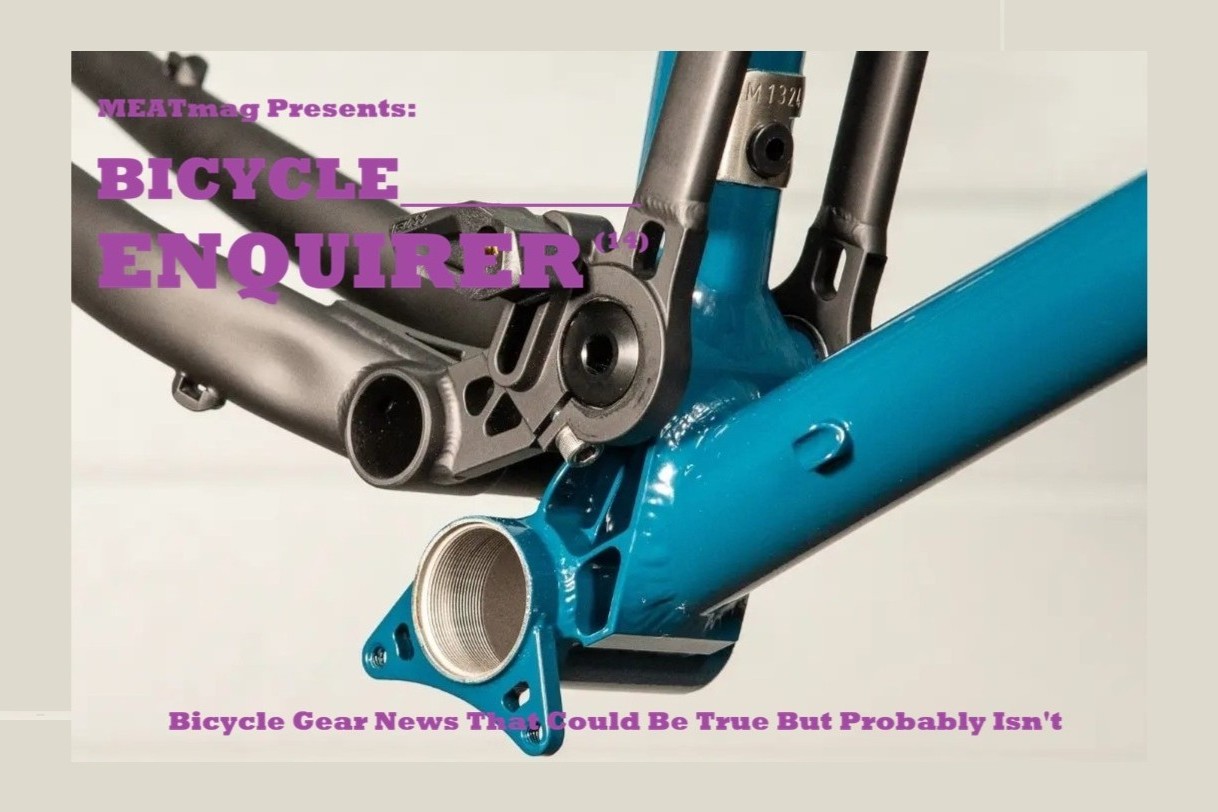
{Bicycle Gear News That Could Be True But Probably Isn’t}
It’s beyond reproach that the classic Horst Link 4-Bar* suspension system is the most successful in the history of mountain bikes. Racing or riding, XC-rambling through DH second-chasing, brands and riders buying into it, you choose the metric. Relatively simple to design & manufacture a great performing sag-wagon, the system can be tuned around the inputs of braking and pedaling forces while also optimizing packaging. Full-length dropper posts, MTeeB motors – including future gearbox/motors, water bottle mounts, down tube storage, large logos, it’s all there.
There are two obvious challenges to brands switching to {almost} the oldest suspension design in the book. After years of touting shock-tunnels, short-links, counter-rotation, faux-bar layouts, secondary suspension members, eccentric BB and/or dog-bone pivots, and simple-single-pivots, going FSR is, of course, admitting that the only reason your designers didn’t use it to begin with, or switched away from it in the noughts, was Specialized’s legal beagles on the scent. The other challenge is, of course, the lack of aesthetic differentiation as all mainstream full-suspension rigs approach temperate sameness. Somehow banal and benign despite awesome ride characteristics. I mean, what’s more important a unique silhouette or a recognizable suspension system? No, really.
*{AKA FSR; a vpp but not VPP design.}

Aesthetics and legacy alternatives aside, four-bar is old-old-old and what the bike industry hungers for now is new-new-new. Bigger wheels alone very clearly are not going to carry us there. Enter every variety of 6-Bar, and Faux-6-Bar*, suspension systems with creative names and axle paths to confuse** and delight. A handful of extra bearings? Yes. But, of course, the difference in performance is also so noteworthy that, while remaining the best looking DH bike in history, ever and forever, Frameworks Racing will never podium again.
Hold on tight to your bars as the pendulum swings back with a radically fresh return to the inventive past of unique looking suspension systems, no boring bikes, and marketing mayhem as brands can once again make bold claims about the relative superiority of their systems. Additional drive chains or shafts, moving linkages attached to moving linkages, mid-pivots, high-pivots, low-pivots, but not no-pivots, that’s for XC.
*{AKA shock-rate-controlling-linkage four bar, à la Knolly 4×4}
**{I’m still trying to sort out the difference between the 2006+ Felt Equilink design and 2026 Yeti Cycles Sixfinity.}


As always here at Bicycle Enquirer, when we’re elucidating the news that could be we like to imagine how some key brands, large and small, would respond if we asked them for comment:
Kona: Developing the new 6-bar Magic Link 3 system was an explosif process, but we took a stab, dialed in our unique roast, and there’s nothing stinky about the units we scored. Equally at home with an air shock or as a coiler. Operator error aside, if you add one to your bicycle entourage, you’re sure to be yelling ‘WOO!’ down every chute and “Yeah, Dawg! This thing is primo, supreme, deluxe!” at the end of every ride.
Atherton: Aluminum, carbon, titanium, we’re already creating interesting looking non-belly-button-bikes by gluing tubes and lugs together like we’re 1970’s Vitus. Like Paddington munching marmalade, we’ve been making this subtle example from DW’s sixty-three different six-bar suspension systems {all the best} since before it was cool.
Transition: What’s faster and more fun than Giddy Up? Wait until you try our new Chop-Chop linkage system, cutting through all the 6-bar marketing bullshit because we’re rider owned and just like your cellphone, city, or Halloween, more bars means more ‘Party in the Woods.’ Send it Randy!
Starling: The beauty of using steel for all our bikes is the magic combination of stiffness and compliance. It’s shed-sorcery, not “next-best-thing shithousery” allowing us to deliver a truly complex ride with only two bearings. #ShedLife! Oh, no, our 6-bar presser is like our Black Friday sale all troll for no dough.
Santa Cruz: Rather than the consumer confusion caused by all our frames looking exactly the same, our designers will now confuse our customers by choosing an optimum suspension platform for every individual application. XC is flex-stay, Trail is Horst Link, All Mountain & Enduro are six-bar-ish, DH-racing is VPP. Remember they’re all vpp designs, but our new 6-bar is also an all-caps VPP design; the original Outland VPP bike was a faux-six-bar after all. Yes, even the new many-link bikes have a life time bearing warranty.
If you’re interested in supporting the MEATengines community there are multiple ways to help out. You can submit an About a Single Speed or Bicycle Valentines piece, or fire me an e-mail if there’s some other ATB or mountain bicycling topic you’re passionate to write about. I’m interested. You can engage with a comment below, join the crew at r/MEATengines, or, if you have a couple spare bucks {ha!}, you can always buy me a coffee. Thank you.
If you’re keen to make a submission, have a question, or otherwise want to touch base please e-mail me at MEATengines{at}gmail{dot}com. Cheers, Andrew.
Leave a Reply