
When I wrote up NSB’s excellent Daemon pedals for NSMB I added a half-serious & half-cheeky comment that they should only come in silver. My reasoning was that with the quality of manufacturing and all the small parts being replaceable the only reason a rider who loves the Daemon would replace them would be to get a fresh-looking pair.
Short of breaking a body, and even then I could replace that individually, I don’t see why I’d need to purchase a replacement set of pedals unless my needs change. New guts are much less expensive. My feet aren’t growing, but maybe for a change in stance I could decide I’d prefer a wider body? Or, maybe I decide to reverse course and go back to riding clipped-in?
In these examples, I’d be looking for pedals that do something different. But given how good they still look after a solid beating and how much I love the feel on the trail it’s hard to imagine that I’d simply want them to be something different. I doubt I’m going to wake up tomorrow and wish they were purple and a different brand was laser etched on the pedal body.

It’s come up again with my new series that has just launched on NSMB which is a continuation of ‘Buy The Bike You Already Own’ blended with min-maxing upgrades called Min-Max YOUR Mountain Bike. I mean, sure, with the right upgrades a 2016 Kona Process is going to absolutely shred as well, or better than putting the equivalent money (used resale value of bike + cost of upgrades) into a fresh rig. But what if someone just wants a new bike?
Okay, it’s their money. But what are they hoping to get out of the said new bike? Compared to the Process I could see a desire for longer chainstays and water bottle clearance in the front triangle. If I had superfluous monies I would consider replacing my Process for the former reason but I don’t know what frame I’d replace it with that has a combination of a longer rear center, big – well-shielded – bearings, a dual eyelet shock, and the ability to install an angle set in the future.
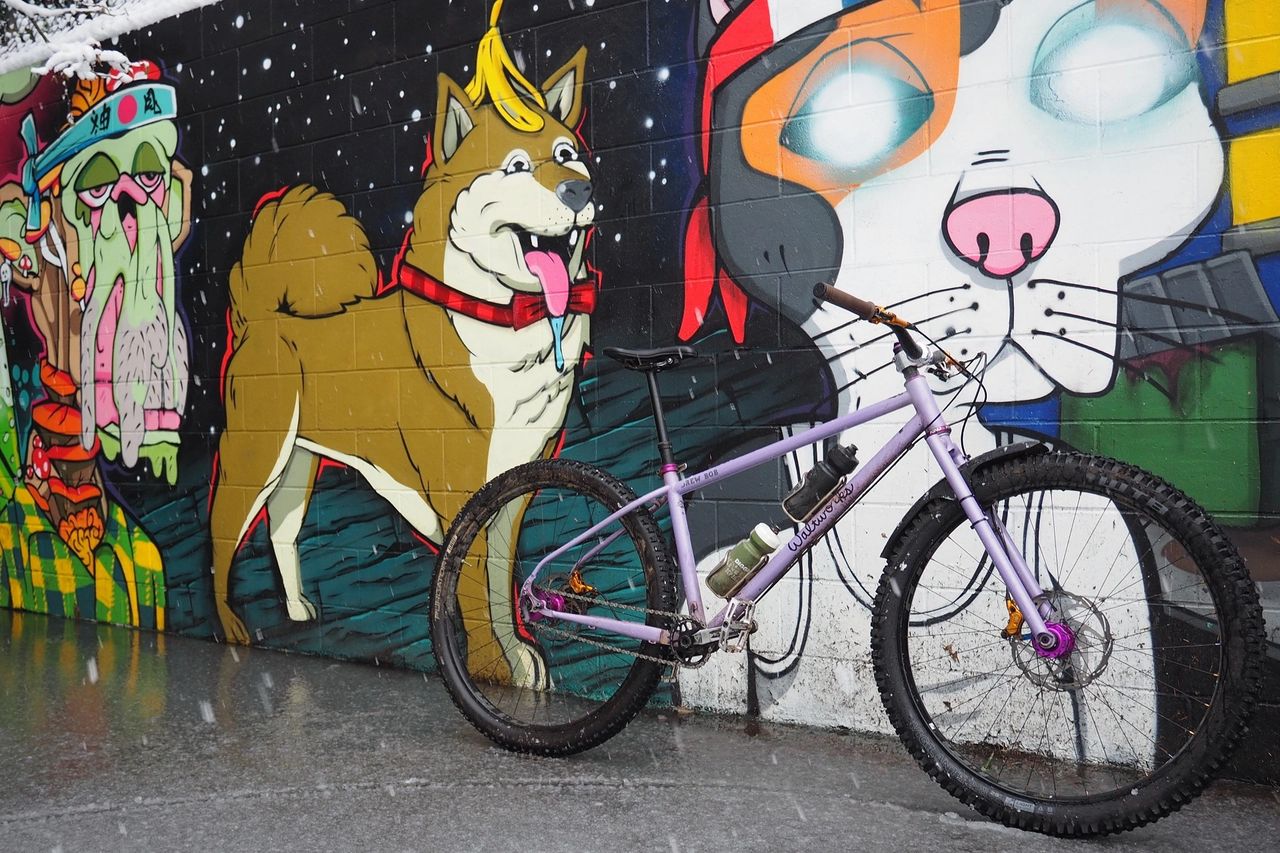
I’ve owned many bikes and every time I’ve switched rigs, usually frames or framesets actually, I was chasing either a different experience or an upgrade to my existing experience. Clearly, if I wanted to run a 180mm fork, or planned to take up XC racing, or was going to switch to riding the bike park every weekend, then I’d be looking for a different rig than my Waltworks – or a Process 134/153 – but in hindsight my application hasn’t really changed in twenty-plus years. I don’t think there’s any doubt that actual improvements in meat-powered bicycles have slowed to a trickle over the last five-plus years.

Some innovations over the last five-ish years – geometry and good Plus tires specifically – have made it plausible to ride my rigid bike on trails I never would have considered previously. That aside, when I’ve had a pair of rigs, my two-bike combo has been a single-speed hardtail and a mid-travel full suspension bike more years than not for two decades.
With my V1 transitioning to take over errand & commuting duties and my V2 settled comfortably into its role as a sometimes rigid and sometimes 120mm forked single speed hardtail, if I wasn’t testing bikes for NSMB, I think I could justify the space and investment – based on how much I love to ride – of owning a second mountain bike rig. And yes, I am bored, not being able to ride, and this is the sort of thing I daydream about riding on the bus after I drop The Clairebarian off at school.
One interesting thing to me is that when it came to full suspension bikes in the past I’ve really only considered buying new ones for a number of reasons. First, who knows how well the bikes have been looked after, and riding a bike with seized bearings introduces piles of stresses for which it isn’t designed. Add to that changes in geometry and sizing that have generally made bikes fit better for me. Add to that an increasing list of no-go specs, like Trunnion-mount, that limits the bikes I’d consider.

Now there are an increasing number of bikes in the recent past where I’d say there are feature and fit reasons that I’d actually prefer the past generation of a product. The seat tube angle will put the saddle in a better position for me, some 27″ options, and some 29″ options, more closely match the geometry I’d be looking at running them as mullets, etc.
Cloud-drawing different imaginary bike-build options, the maximum, usable, Lego-factor actually becomes a big part of my imaginary purchasing decision. Within the range of trails, that time has shown I will generally want to ride, what suspension bike or frame would give me the most different, good, setup options. Essentially, if you’re generally upgrading because you want your bike to do something different – rather than simply be something different – there are some machines that are much more likely to have staying power than others.
I find myself wondering how often that’s a deciding factor when folks are buying bikes? With hardtails, there is always the next life – as a commuter or city bike. But, in the past, buying a full suspension bike for the moment, I admit I never considered if Bike-X had utility beyond what I intended to use it for at that moment. There are certainly 100mm travel bikes that would have been 120mm bikes and 180mm travel bikes that would have been 160mm travel bikes.
Making a circle, I’m thinking of adding a MEATengines series on imaginary full suspension bike projects, for me. Projects like my Yeti SB104 Before Brunch Ride, except that they’d only be on paper. All machines that I feel I could commit a half-decade too at least thanks to a high Lego-factor and the right mix of fit, features, and finish.