
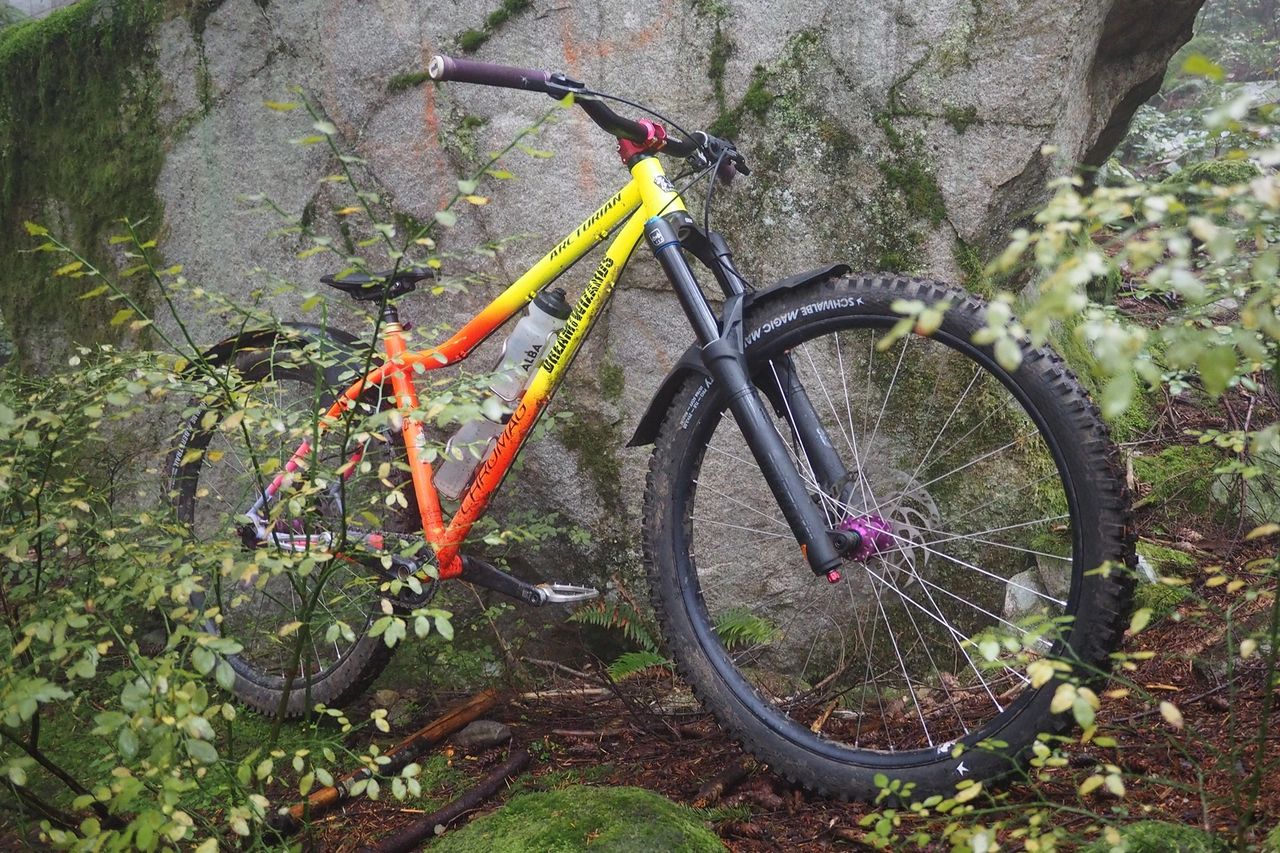
Yep, That’s Still Rad.
My least favourite part about reviewing bicycle stuff is the wordless wastelands between an initial look and/or first impression piece, some future conclusion, and a long-term follow-up. Sure, there’s the occasional internet or interpersonal follow-up query. You know, “Are you still loving those Project 321 G3 hubs?!” or “Pendulum pedals are now in stock, I know you said they aren’t for everyone, so, should I buy some?” And, yes, I do regularly follow up on products with an [Aside] or in SBTISAOAF.
Anywho, it turns out those updates are often lost in the other noise. So, going forward, I’m going to do a better job of bridging these multi-piece, partisan, partial, and pre-disposed review series by plugging away at some more regular little updates.
Today, I’m taking a brief re-look at SR Suntour’s Durolux 38 RC+ fork, Stooge Cycle’s Moto Bar, and the 3D printed version of BikeYoke’s Sagma saddle.

SR Suntour Durolux 38 RC+
[Aside] This is supplemental to my Durolux RC+ First Impressions & SuspensionWerx Teardown. [/Aside]
At this point, I can say with certainty that the Durolux 38mm experiences the same ‘issue’ as every other 38mm fork I’ve ridden, with the notable exception of the somehow-still-great-when-roached DVO Onyx D1 SL. That is to say, when you combine the seal-and-bushing contact of a 38mm chassis, a healthy dose of riding, and a very slack head tube angle, the performance becomes hand-wringing-harsh before the theoretical maximum time elapses for a basic or full service.
Put another way, when I neglect to service my 36mm stanchioned Durolux EQ, the ride is less harsh whether I’m overdue for a basic lower lube or a trip to admit my suspension sins to the Pope of Plushness @ SWerx.
Interestingly, I’ve had this same chat over the last couple of weeks with friends riding the Zeb, Ohlins 38, and Fox 38 chassis, and I’m fairly convinced that the issue may be a benefit rather than a bug. A couple of them are previously convicted fork abusers. And, we’re talking, bushings-eating-stanchions level abuse. So, the fact that they’re thinking about service is a win for everyone.


Running from fresh until recently, the 38mm SR fork holds it on against any major-player 38mm fork on the shop floor. It has a wide range of usable damping performance, and it’s happy to be run softer or firmer, in terms of sag. Larger folks, thinking they want a beefier fork for the front of their long travel rig {eeb or meb}, can’t go wrong here. And the build quality per dollar is impressive.
In a straight-up moment of reflective honesty, the ultimate ’25 SR fork for my use case is, probably, actually the 36mm chassis Auron RC+, which, yes, would drop 1cm of travel {160mm max}, but also a chunk of weight, but retain the wholly positive updates to construction and damper. My 170mm Durolux 36 is plenty stiff for my plunking, so I assume the Auron would be the same story.
Here, one almost has to wonder if there’s an off-menu option to run a 170mm Durolux 36 air spring in said Auron RC+, or if, like the latest Lyrik forks, the bushing overlap and damper allow for a maximum of 160mm travel. Maybe an Auron RC+ damper would stroke to 170mm as an update for my five-year-young, many-times-serviced, still doesn’t creak, 36mm Durolux EQ?
Yep, that’s still rad too.


Yeah, so. From Cumberlandworx through summer and then hitting some North-Shore-gore, the Durolux 38 RC+ has been an excellent experience to date. It’s easy to set up and rides well both with a less-damped-more-ramped setup as well as the on-trend combination of more sag and more low-speed-compression (LSC) damping.
I’ve had an excellent experience running it with 29×3″ XR4 plus tires with CushCore inserts, and now balancing the ride with 29×2.5″ Schwalbe semi-radial rubber as well.
In addition to any side notes in SBTISAOAF, my plan is to drop the lowers this weekend and then roll back around when the fork is due for its full spa day.

BikeYoke Sagma 3D
I have a lot of hours on the Sagma 3D since my first piece in March. I wouldn’t say that my experience with my new favourite pedaling perch has changed, but it’s certainly evolved. The 3D printed material is as new despite some proper sandpapering rides*, and any concern I had about the saddle’s texture vs. a properly sweaty ride proved unwarranted.
The extra traction in the wet is something that anyone pedaling in a rainforest should mark down as a pro. Much like jumping back and forth between different tires or brakes, when I drop in on a wet ride with another saddle, including my well-worn Sagma, it takes some adjustment.
*{Before I was grom pressured into running an anti-theft device/fender.}

My one complaint with the 3D-printed Sagma saddles carries forward from the standard Sagma saddles, and this is that BikeYoke makes a less expensive non-suspension version, called the ‘Lite’.
I recognize that the Sagma suspension saddles are not in everyone’s budget, but my feeling is that someone min-maxing saddle performance and looking for a similar shape would be best served by limiting their budget to one of the more basic WTB Koda saddles.
And, more importantly to this conversation, someone with the budget for any BikeYoke saddle will be much, much better served over the longer term with the extra investment to buy into the comfort boost and replaceable-part construction of the suspension versions.
I have hundreds of hours of riding on an original Sagma Lite, and even without the suspended rails, it’s a great saddle. But, especially for off-road or gravel riding, I’d spend the extra bucks for the freer movement and comfort boost of the suspended version. Every time.


A few friends have noticed, carbon skeptic that I am, aside from lever blades in wintertime, that I’m running the fantastic-plasticized version of the Sagma 3D. This is a settle-a-bet situation. I’ve long been vocally anti-carbon rails for mountain bike saddles, and I’d still personally save a few bucks and eat the 20-gram hit to run aluminum.
That said, Sacki at BikeYoke is very confident in their carbon construction, so revisiting my bias is part of the long-term review of this product. I’ll be back with more words when there’s some notable update or another 1/2 a year from now. Whichever comes first.

Stooge Moto Bar
It’s been over a year of riding on the Moto Bar, and for more about the Moto Bar, I’ll encourage you to check out my Oct 22nd, 2024 piece, More About The Moto Bar. Ha.
As we’ve discussed a few times, rise is a funny measurement with no real standard amongst different brands. The Stooge bar, at 38mm, is taller than some bars claiming more rise, and at the same time, I think Andy et. al. would be well served to offer a higher-rise version. Say, 58mm {or 68mm}.
Aside from the -17° {AKA 17° back} sweep that puts it in the middle of my 14-20° off-road alt-bar happy space, my favourite feature is probably the aesthetically unique and uniquely practical, long 31.8mm extension that’s lovely for clamping accessories {in my case, lights}.


This long straight section does lead to a limited amount that one could cut down the Moto Bar and still fit controls. Perfect for me, but if you’re thinking narrower than say 780mm or maybe 760mm, depending on brake levers are positional-preference, there are other options in an alt-bar worth considering.
It would be torture for ye olde SKU count, but I could see Stooge offering, in addition to a higher rise version of the Moto-800, a narrower Moto-760 with the same bend and grip area {so trimmable down to say 720mm}, but featuring a 40mm narrower middle section.

Putting aside talk of adding this bar-SKU or that, Stooge does really hit the nail on an alt-shape, medium-rise bar that will work for a maximal number of riders seeking a slightly different hand/wrist position.
The Moto Bar is reasonably priced, buying one means supporting a rad small brand doing neat 50,000:1 stuff, and I imagine most riders, like myself, will be content to keep riding whatever stem length works for them with a standard 7-9° backswept handlebar.
It’s the 10th anniversary of the Moto Bar this year, and they’re currently in stock, which is two great reasons to order one up if you’ve been looking for a little push off the fence.

Okay, and that concludes this round of ‘Yep, That’s Still Rad’ updates. If there’s a MEATengines ABRS product that has you curious for an update, please feel encouraged to drop me an e-mail, and I’ll fire you a paragraph and add it to my update-pending list.
Cheers,
Welcome to MEATengines, I hope you enjoyed this piece. If you did, please consider buying me a coffee. Any questions, concerns, or comments; feel encouraged to drop me an e-mail, or join us at r/MEATengines.