
My interest in electronic drivetrains these days is purely related to turning wrenches. Fixing other people’s bikes. Frankly, no one is asking for my thoughts as a reviewer of the latest and greatest in robotic chain derailing and that’s fair.
Even in cases like SRAM’s XO T-Type where the product absolutely works as advertised, I can’t not talk about buying a whole CUES U6000 groupset for the price of a derailleur cage {with clutch}. Or, how amazing SRAM’s old 11-speed cable-actuated one-by groups were/are. Or, from making a pitch for LinkGlide XT M8130 for the rider who wants high value and high performance. Or, preaching the fun factor of friction thumbshifters. Or, nominating Shimano Zee 10/11 for a lifetime achievement award. And, um, single-speeds.
{I mean, look at me. I can’t even write a preamble for a piece about electronic shifting updates without including all that stuff.}
I’m wired to wonder if batteries were, and are, really the answer to any questions around shifting solutions. Still, I want to talk about a couple of fresh gear-changing component happenings, which, unsurprisingly, are batteries included. So, from here forward I’ll be attempting to simply cover some news. It’s an AYOO piece – add your own opinion.

T-Type Goes HG
I didn’t follow along at all with the launch of SRAM’s S1000 groupset except to notice that they had decided to make it non-series instead of calling it NX T-Type.
[Aside] Okay, I also had to wonder if it was something SRAM really wanted to make or if they were pushed into it by all the companies looking to price-point their bikes that have frames without cable routing.[/Aside]
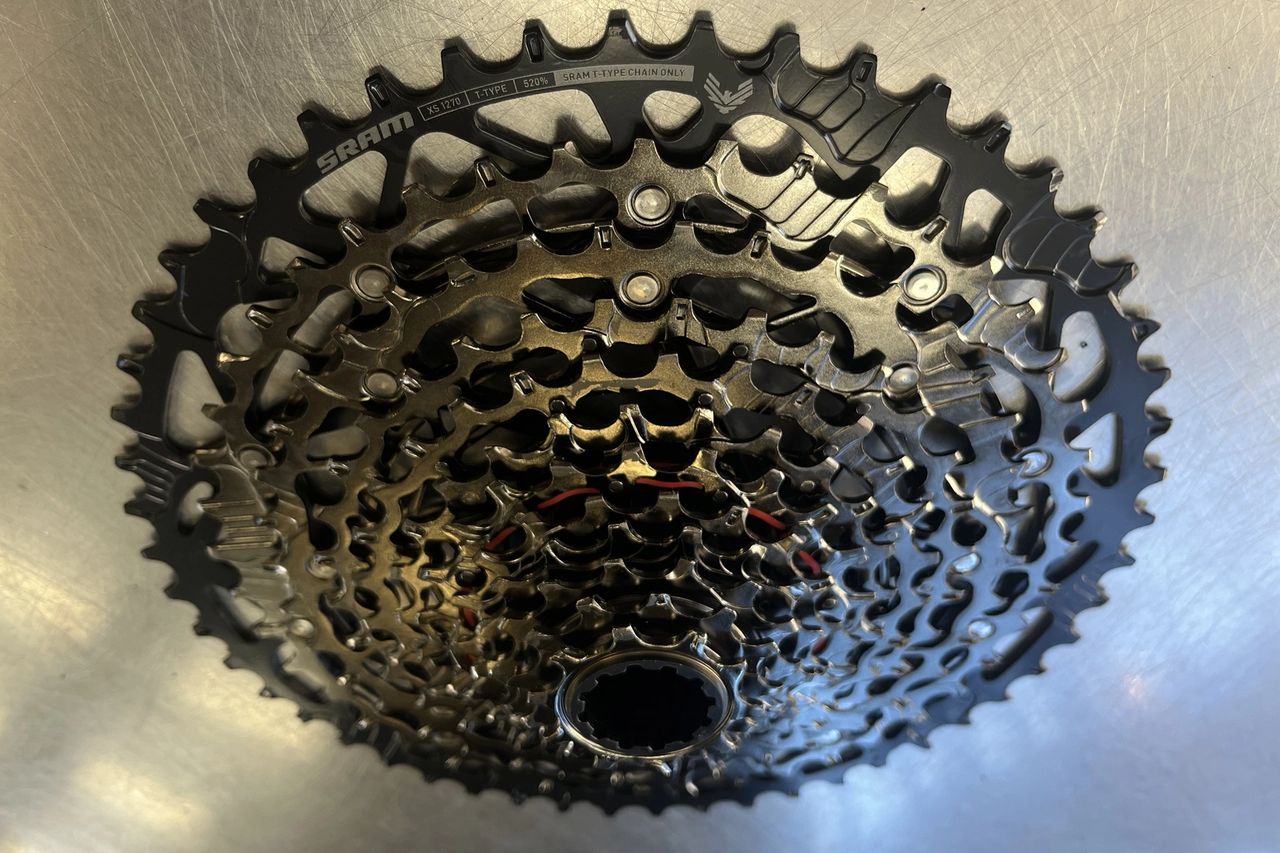
This is their OE (original equipment) focused drivetrain, and it‘s very much a GX crate setup with obvious cost savings to the crankset, derailleur cage, cassette, and freehub body. Freehub body?
Yes, something I missed in the initial launch of S1000, and that has interesting implications in where cable-actuated T-Type drivetrains will go {read: NX & SX level} is that the S1000 cassette options include a classic HG driver as opposed to SRAM’s XD system.
The HG driver has existed since around 1980 and is still prevalent on budget-friendlier mountain bikes. SRAM (SX & NX 12-spd) and Shimano (LinkGlide & 10/11-spd) still use HG drivers for many of their mountain bike drivetrains, but their higher-end setups switched to newer standards that can accommodate a 10t cog. For SRAM drivetrains, like the rest of the Transmission (T-Type) electronic groups, that’s an XD driver. For Shimano’s 12-speed drivetrains, that’s a MicroSpline (MS) driver.

What’s maybe most interesting about SRAM’s option of the HG driver for S1000 is that it still uses a 10-tooth cog for a 10-52t (520%) gear range. Any other drivetrain being combined with a standard HG freehub body is limited to an 11-tooth high gear.
As with other T-Type groupsets, swapping SRAM’s Universal Derailleur Hanger (UDH) for the full-mount rear derailleur creates enough extra space to move the cassette outboard. Making for a straighter chain with the now common 55mm chain line, allowing 10t compatibility with the HG driver, and allowing the easy transition to a 13-speed setup in the near future.
Putting aside cost savings, I could see some brands choosing to spec the XS-1275 (XD) cassette rather than the XS-1270 (HG) cassette on their S1000 bikes to maximize inter-compatibility. Especially with small to medium-sized brands trying to offer some degree of mix-matching with builds. So always best to double-check before buying a replacement unless you also want to end up buying a hub driver.

Shimano’s New Di2 Goes to 13 Speeds
I’ve been guessing since the advent, the reset if you will, of LinkGlide drivetrains that Shimano’s end game with mountain bike shifting would be to have all their cable-actuated drivetrains {now topping out at the XT level} using inter-compatible LG 9/10/11 speed shifting, built around 11-speed cog spacing and chains, and that all their HG+ setups, from Deore through XTR, would be electronic. I would still guess that this is the future.
We also know from premature product spec sheets that the first of the new Shimano Di2 drivetrains will be 12-speed. It’s now the worst-kept secret going that both Shimano and SRAM are ready to make the jump to 13 gears for their wireless 1x drivetrain setups, which will only require a cassette and an update, so what the heck are they waiting for?
My theory is that neither company wants to be first and wear the thorny crown of change-for-the-sake-of-change, but if they’re going to do it anyway ShiRAMano might as well have an urSkek moment and release their thirteen-speed setups concurrently.
{For a deeper dive into the new Di2, check out this solid Bike Rumour article from February 7th. And, yes, I know I added a ‘u’ in there – I’m exporting Canadian culture one properly spelled word at a time.}

Easily the best part about jumping past twelve gears is the rhyming opportunities for the marketing materials. I mean off the top of my head we have “Thirteen is Serene,” “Mean, Keen, Thirteen!, “Thirteen Machine.” I bet I’m missing all sorts of good ones.
From a shifting perspective, the big question is whether they will grow the gear range past 510% (Shimano) and 520% (SRAM) or if they will infill the existing range to achieve smaller jumps between gears. My guess is both brands will hit that 10-52t (520%) gearing and then deliver smaller jumps in the mid-range gearing.
Phew, and just like I’ve managed to dump all my battery-shifting brain waves in one place and now I can go back to daydreaming about getting some Chromag Surface Voyager dropouts welded onto my Will’s Arcturian.
Welcome to MEATengines, I hope you enjoyed this piece. If you did, please consider buying me a coffee. Any questions, concerns, or comments; feel encouraged to drop me an e-mail, or join us at r/MEATengines.