

Monday Musing (#44) – {Almost} Every Rider Future Tech
My friend JacVenture and I were out on a greasy Fromme ride this week. Riding a shared favourite combo of Karen’s Boundary Trail into Lower Crippler. Me on my over-forked Arcturian Voyager one-speed and Jac on her treasured but tyrannized Bin-Chicken HD6.
We’re both card-carrying members of the almost-instant hub club. Particularly fans of Project 321’s G3 hubs, but on this given day, Jac was testing out an e13 Sidekick hub that delivers deadband to the tune of 12°, 15°, or 18°. Though annoying for technical climbs and trials-like trail sections where <5° hub engagement rules, even as a spectator, the drivetrain uncoupling effect was obvious in how well her suspension was working in the downhill chunk. Jacnoquie is so stoked on the {downhill} benefits that she’s already ordered those same e13 hubs for her DH rig.

{Above photo: SRAM}
She’s among a plethora of people chasing this pedal-suspension separation. And, yes, it’s not that drivetrain decoupling for downhill riding is a super-fresh idea; it’s been front of mind for plenty of bicycle thinkers since, at least, 2019. That’s when Gee Atherton swapped a cog for a spacer in his cassette to create a no-pedal-feedback neutral gear. Rather, it’s the availability of some products that allow for adjustable drivetrain float that has made it accessible to anyone with the scratch.
But what’s clearly missing from the market, at least until SRAM releases Ochain AXS, Ochain Flight Attendant {the automatic version}, and, hopefully, Ochain Cable, is a system that lets one reap the benefits of both. An almost-instantly engaging hub for technical climbs and trail riding in general, and enough deadband to let the suspension work as if chainless on downhills.

{Above photo: Andy Vathis/Pinkbike}
Even on extended downhill sections, with Ochain, Sidekick, etc. in open mode, the importance of lightning-quick hub engagement, after the deadband, will likely come into play for most of us. When riders go to put in a few pedal strokes. This comes down to how multiplying floats builds in a huge degree of engagement uncertainty.
For example, combining an O-Chain set at 12° float with a hub that has 0-to-20° engagement, like a classic 18t ratchet drive, provides an engagement range of 12-32°. On the other hand, when it does come time to pedal, pairing that 12° O-Chain with a 1.25° P321 G3 hub has a much more consistent engagement range of 12-13.25°.

{Above photo: SRAM}
Okay, sold for DH riding, but whatever money exists in the mountain bike market revolves around selling products to the average user. Is it a lot of development and marketing money just to serve the shuttle market? Okay, there’s also the overrun and future throttle markets. But still, some percentage of folks riding MTeeBs prefer fast rear-hub engagement going up & across as well.
So remote adjust for deadband makes logical sense, but how hard folks buy in for trail bikes {Tech-C through Enduro} will depend on cost and options. And, cost comes down in part to volume.
I’ll say now, for folks riding full suspension rigs, which is most mountain bikers, I foresee this product category being as prevalent as dropper posts. In fact, I’d guess that like 1x drivetrains, these systems will become so commonplace as to influence suspension designs & kinematics with manufacturers assuming that every sag wagon that isn’t being starved of extra grams will be run with one.

{Above photo: SRAM}
[Aside]
I also think that separating the rear hub from the decoupling system, à la Ochain, is the smartest way to go in terms of redundancy, simplicity, and unsprung weight. But, I’ll let e13’s and, in the future, Fox Face’s marketing departments battle that out with SRAM.
[/Aside]

{Above photo: Never Forget HammerSchmidt}
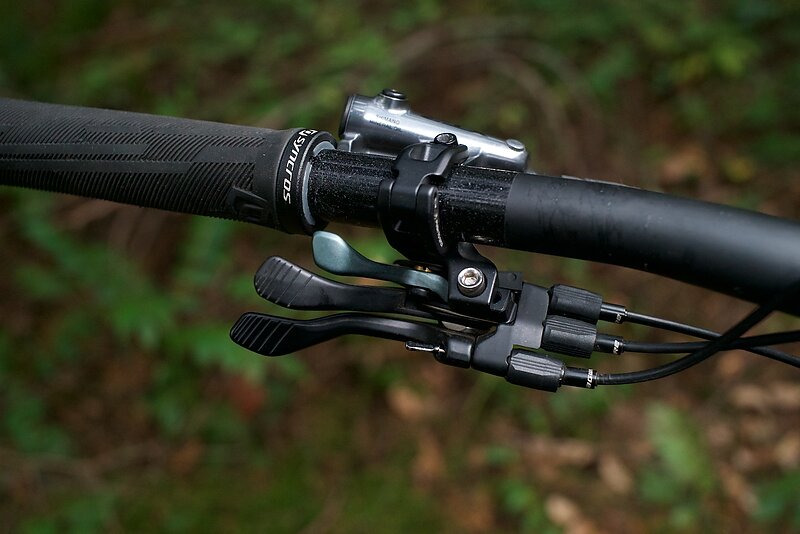
As with T-Type drivetrains, I’m certain that SRAM’s first remote-lockable Ochain will be an AXS battery-powered product with actuation integrated with the dropper post remote. Here I’ll note that, for trail bikes, it would be a mistake to tie the two features to a single push; plenty of folks lower their saddles for better bike-body separation on technical climbs and trail features where fast hub engagement is nice.
Then, there’s an obvious argument for a Flight Attendant version that sets the Ochain deadband based on communication with the bike’s suspension. I’m a grump when it comes to Flight Attendant and bicycle automation in general, but this is one feature where integrating the technology would have an obvious performance benefit.
Finally, as with T-Type, the mass adoption of this technology on the trail only really makes sense if there’s a cable-actuated version as well. Ochain TwistLoc? Scott-style tower remote? I’m sure whichever way they go, if deadband does see mass adoption, the aftermarket will deliver many options.

{Above photo: SRAM}


{Above photo: Chris Grundberg/Freehub Mag}
I suppose this is the point where I swear that I have no inside information about what Ochain developments SRAM has coming. And I don’t. But this product makes too much sense not to exist for every level of performance drivetrain – 70, 90, GX, XO, XX.
And, as with other changes that have swept through mountain bikes in their time, the fact that there’s a ready performance benefit any {full suspension} rider can feel is a solid predictor of future mass adoption. Think disc brakes, dropper posts, tubeless, 1x, and mature bicycle geometry.
On-demand drivetrain decoupling, maybe even adjustable on-demand drivetrain decoupling, seems destined to eventually be OE equipment at almost every sag wagon price point.
And if this is at all triggering, just remember that single-speed hardtails & double-hardtails remain an excellent option for most trails!
Welcome to MEATengines, I hope you enjoyed this piece. If you did, please consider buying me a coffee. Any questions, concerns, or comments; feel encouraged to drop me an e-mail, or join us at r/MEATengines.