
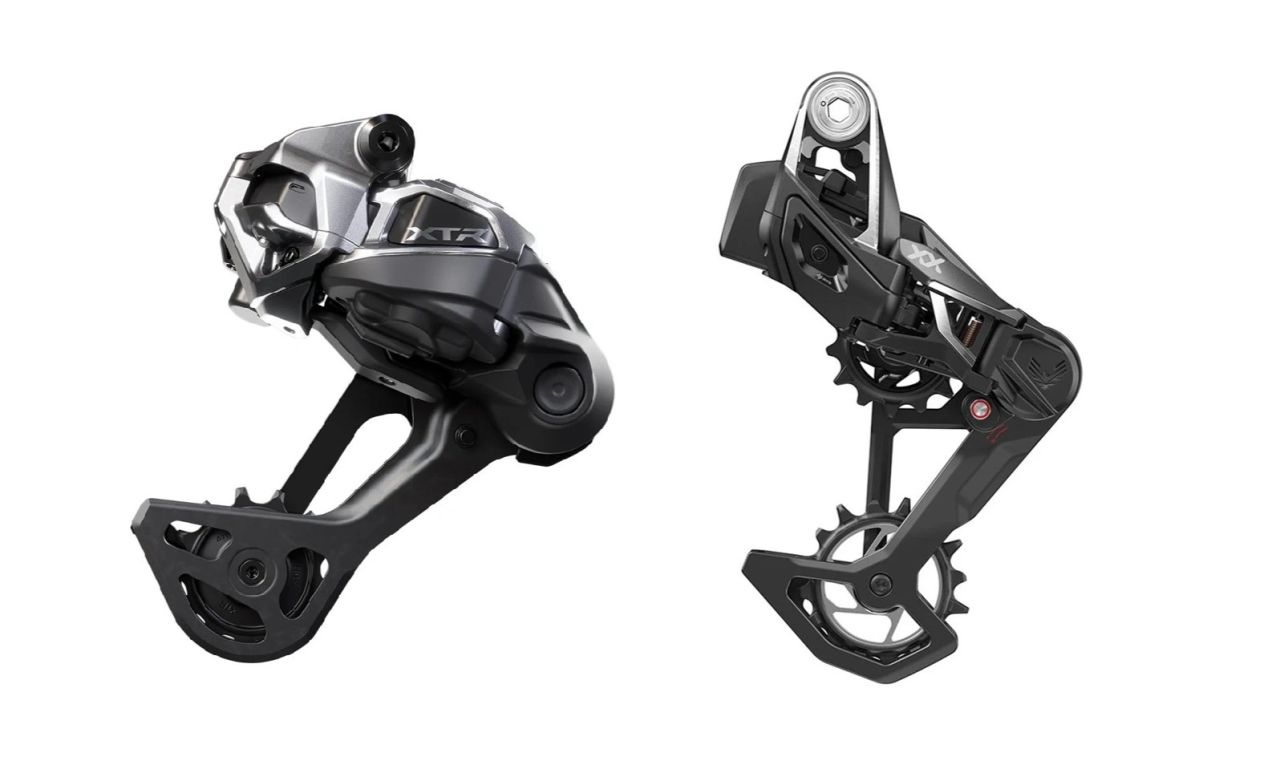
ShiRAMano vs. ShiRAMano
Since the advent of AXS, I have oft wondered aloud, and at least once in writing, what percentage of the end cost of wireless robot shifting covers warranty replacements. To briefly revisit, in the past, derailleurs either worked or they were dead, and the only way to fix the latter issue was for the rider to buy a fresh one. A fairly standard derailleur-smashing conversation went something like this:
Rider: “My derailleur exploded!“
Shop: “What did you smoke it on?“
Rider: “Your know that <insert feature> on <insert trail>?“
Shop: “Yep.“
Someone is going to bring up JRAs – Just Riding Along – but all jokes aside, most of these protestations were easily defeated at the service desk by raising one’s eyebrow and counting to ten. Oh, obviously, the counting happened silently in your head. Often they were concluded by the rider saying something like, “I had to ask!”, “Okay, fair enough, what’s the best possible price on a replacement?” or, “Exactly the same thing happened to my friend Dave* and his was covered!?!”
*{No, I don’t know why dude’s named Dave seem to receive the friendly fresh freebies.}

Here I’ll note I’m not knocking the SRP of digital derailleur design. These are luxury products that {almost} no one really needs to enjoy riding bicycles. They cost a pile to design and manufacture and they’re sold in limited-enough quantities that cost per dollar earned is a real question. Add in ongoing firmware updates and application development that brands haven’t figured out how to charge for and there’s real money being spent here. The only ongoing updates thumb-powered derailleurs ever needed were cables, housings, and jockey wheels, and riders paid for those, so the costs to the manufacturers was down to manufacturing and storing them.
But these days, there is a warranty grey area where even a pummeled, pulped, and pressed derailleur – we’re talking fully run through the juicer – may be eligible for a no-charge-replacement {or, upgrade} as long as it can still grab gears on the day its battery interface quits. Full-power to the riders, but sometimes the parts being replaced sans charge, well, it’s something. And something rarely adds to nothing.
And, yet…


{Photos: MEATengines}
Lately I’ve been hearing, and seeing, a bunch of chatter about the battle between SRAM vs Shimano wireless groupsets in the mountain bicycle, gravel, and roadie spheres. Plus the eeb-equivalents of all those. I suppose it’s only natural for folks to weight {sometimes on a scale even} and measure the two dominant developers of our deluxe derailleur duopoly. Top Gun vs Di2. Journey to the debit zone.
I don’t actively follow along, but the tune is something like: SRAM is ‘winning’ because X, or Shimano is ‘winning’ because Y, and, for some reason, an aside, neither X nor Y is ever down to limit screws. Am I the only person who would choose one derailleur over another based on being able to manually adjust the limits?! I know, “Breathe.”
The simple fact is, though, when it comes to winning, I’m pretty sure that both of these chain-moving-champions are tied for a solid-gold medal. And this is largely because the, yes, arguable, sweetest shifting, lovely for longest, most smashingly survivable, highest-end, super deluxe, cable-actuated derailleur ever made, the SRAM XX1 X-Horizon 11-speed, rings in around CA$475. The almost as good 12-speed version is about the same. And, the T-Type AXS battery-powered equivalent is over double that price at SRP.

{Photo: MEATengines}
And the thing I’ve noticed that’s most interesting, and also maybe most ominous, goes way beyond the fact that some folks prefer SRAM shifting, and some folks per Shimano shifting, and some folks are agnostic regardless of price point {and I’m not telling folks what to do with their money – you’re happy with your robot derailleur? I’m happy for you!}. For me, the ‘thing’ is the way that suddenly a CA$275 Eagle 90 cable-actuated derailleur is perceived like a bold bargain. A CA$180 XT M8130 derailleur is practically a steal! I even had a friend talking about the relative bargain of, luxury-level, Shimano XTR cable-actuated drivetrain relative to the Di2 wireless version.
Cable-actuated Shimano XT is not “The new Deore.” Shimano Deore is the new Deore and whether it’s HG, HG+, or LG the stuff works very well for the money. XT, as it has always been, is an upgrade in materials and manufacturing, for an extra outlay of monies, that will well-serve someone putting in the miles, longevity wise, but doesn’t offer a truly significant upgrade comparing two fresh shifting systems.
CA$180 is still a relatively substantial chunk of change to spend on a bicycle component. Especially when the excellent Shimano Deore M5130 costs 50% fewer beaver-bucks, and in the grand scheme of bicycles it’s still a premium product. That’s true of many of the upstart drivetrain brands as well. A rising tide raises all ships.
Anywho, next time you’re thinking about which ‘S’ brand is winning the drivetrain wars, they both are. And the next time you’re thinking about the relative value of cable-actuated drivetrain components, please don’t include servo-shifting in your calculations. You can still buy the best cable-actuated derailleurs made, XX1 & XTR, for around four-bills.
Welcome to MEATengines! Whichever way you rolled here, I hope you enjoyed this piece. If you did, buying me a coffee is always appreciated but never expected. Any questions, concerns, or comments; feel encouraged to drop me an e-mail, or join us at r/MEATengines.
.