

I’ve been thinking about hardtail geometry a lot lately. I’ve been over-forking bikes, under-forking bikes, and generally exercising my new motto: Mullet Everything!
When I use the term ‘rule’ I want to first acknowledge that mountain bicycles would be pretty boring if they all looked the same and rode the same. Design and geometry could be better optimized for where and how the machines will actually be used – not just consistently longer, lower, steeper, & slacker. Companies could be clear about how and where their bikes should shine instead of just claiming “logic-defying” best-at-everythingness.
The Rule Of -2° acknowledges that physical bike geometry doesn’t always match the geo chart. Especially with hardtails where companies sometimes use sagged geometry, sometimes un-sagged geometry, and sometimes a mix of both (just publish both, please). It also acknowledges that effective seat tube angle measurements are useless without including a saddle height – or better yet multiple saddle heights a la Banshee.
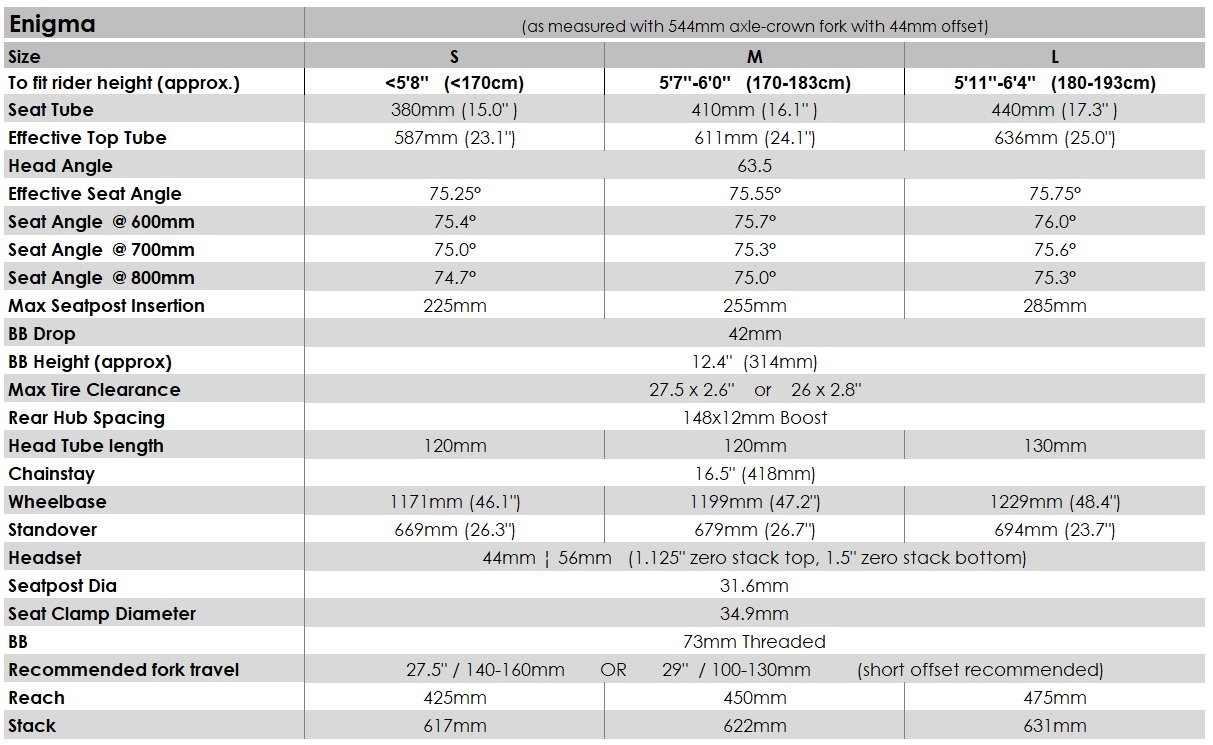

What the Rule Of -2° does is provide bicycle manufacturers with an easy template to make great hardtails assuming they already make a great full-suspension bike in the same category. Take said great full-suspension bike and account for how a hardtail sags and changes geometry through its travel by subtracting 2° from the head tube angle (HTA) and seat tube angle (STA). Easy.
Arguably the static Reach measurement on a hardtail should be shorter as well since it grows through the travel. The Stack measurement should be taller as well since the bar height gets lower as the bike pivots around the rear axle. But then I’m going to some consensus here, and opinions on optimum Reach and Stack on hardtails for a given size vary as much as those relating to chainstay length.
The beauty of the Rule Of -2° is it adapted off any company’s ideal full-suspension bike geometry for the same sort of rig in a hardtail format. Here again, there is conjecture around optimum hardtail fork travel for an application, but for purposes of playing with the concept I’m considering fork travel as the sole data point for pairing rigs. So my 140mm-forked El Roy, the Marinster Truck, for example, would pair up against Marin’s 140mm-forked Rift Zone 29″.

I have a number of examples comparing different brands’ full suspension and hardtail options, but just by sheer hours on the trails, the bike I keep coming back to is my own El Roy. Despite my best efforts to get used to the super steep seat tube angle (SSSTA), I’ve come around to the idea that an offset head dropper post is the best answer to creating the fit I need for creating power anytime trails are not straight-up steep.
[Luckily there is plenty of steep pedal-and-plunge riding locally, where the SSSTA position is effective for me]
Comparing it to the Marin Rift Zone 29, and using the rule of -2° the un-sagged STA on my Marinster Truck is about three degrees too steep. Not that I wouldn’t personally prefer a seat tube angle even slacker – and clearly there’s personal preference and physiology in every fit decision – but if for the 140mm-forked Rifty’s terrain and application, Marin feels that a 77° STA is optimum then, measured the same way, the seat tube angle on the 140mm-forked El Roy should be 75°. Not steeper than the Rifty at 78°.

Another example I’ve been looking at recently is the Rocky Mountain Growler – back on my list of hardtails that I think are rad now that they’ve ditched the shitty Clark’s brake spec. The Growler sports a 150mm travel fork so by means of my, perhaps oversimplified, comparison the full suspension equivalent would be Rocky’s Instinct.
The Instinct has variable geometry, thanks to their Ride-9 system, but I’m using the neutral geometry setting for two reasons. Firstly, it’s in the middle, and also because I think the Growler is a pretty rad bike and with the Instinct in neutral the Growler is a Rule Of -2° bike.
The neutral Instinct has a 66° HTA (65.7°) and a 77° STA (76.7°) and the Growler has a 64° HTA and a 75° STA. Certainly, I’d be in favour of the Growler being a bit slacker upfront, given its 150mm travel, so I’m not going to argue with anyone who suggests that the Rule Of -2° should instead be applied to the slackest Instinct setup. In this case, the Instinct’s 65° HTA (65.1°) becomes 63° on the Growler and the Instinct’s 76° STA (76.1°) becomes 74°.
Combined with the Growlers 475mm Reach, 643mm Stack, and 435mm rear center – for a size large, static geo – and I’d say that’s in Unicorn territory for most people looking for a 150mm hardtail.

And that’s that. From XC-Race hardtails to full-on Enduro hardtails there’s a simple system that any bike brand can use. And for brands with killer hardtails, there’s no reason it can’t work the other way as well. Just take whatever hardtail geometry works best for your brand, terrain, and customers and add 2° to the STA and HTA and away you go.
Okay, yes, optimizing bicycle geometry is always more complicated than looking at a single number, or even two, but I can’t help believing that a lot of hardtail mountain bicycles would be better if their designers kept this simple formula in mind. It’s not about uniform mountain bicycle geometry for a given category, it’s about equalizing geometry within a given brand.
The Rule Of -2°.