
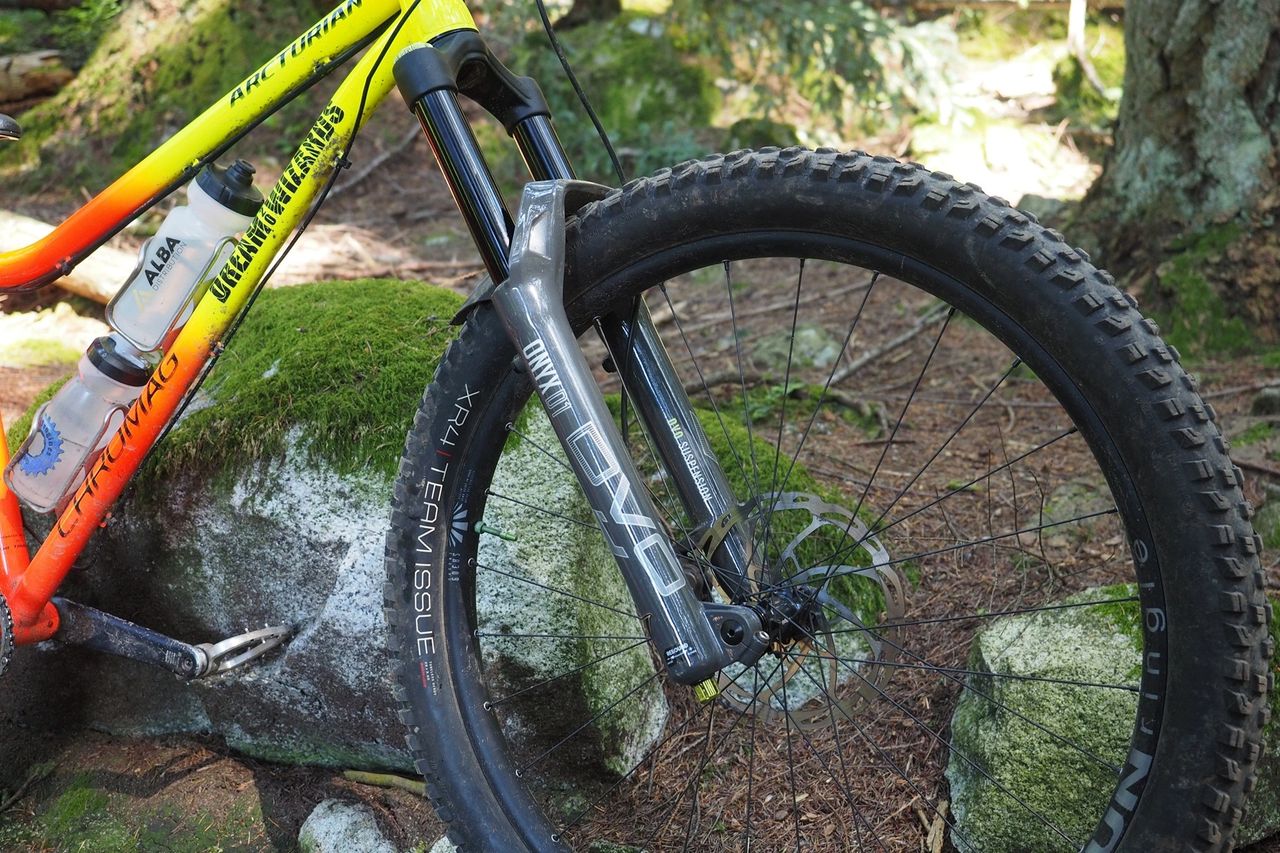
Plushier, Supportier, Happier, Continued.

The New Introduction
My last look at the 38mm stanchioned D1 SL has been largely ready to go for a while. I’ve been back riding my own fork, a 36mm stanchioned SR Suntour Durolux, for a couple of weeks. Just need to sprinkle in a few setup thoughts and push go.
The thing is, I’m typically never going to sit here and write that you should consider this fork over a Fox 38 Factory, Zeb Ultimate, Ohlins RXF38, Mezzer Pro, etc. All awesome options you’ll probably be stoked on. The Mezzer’s IRD system genuinely does some things differently, which I love. The Onyx 38 D1 SL is a worthy competitor to any of them, with key positives being performance longevity, dialed air volume, and smooth⁵* [x] supportive damping.
But I’ve caught myself. Busted. In person. The other day, on a ride, I was waxing poetic about the Onyx to a couple of friends riding the crème de la compétition. “It’s the upgrade.” I was on a call with Aaron from PNW Components and found myself actively selling the idea of riding the DVO SL**. Outside of this copy-and-paste-able-accountability chamber, I’m apparently willing to double down on the Onyx as optimization.
That comes with caveats. I’m the every rider, not the super shredder. I’m, after all, the much-slower, older, shorter, fatter Matt Beer. More plunk than pop, more heavy-on-the-brakes than high-speed-mistakes, more smooth-is-fast than fast-is-fast.
Take it with all the salt you can handle, but in pre-published retrospect, if you’re going to try one premium big-bike single-crown fork and don’t have an insurmountable loyalty to a given brand, well. Combine the Onyx 38 D1 SL, a modicum of setup time, and an open mind, and I’ll be surprised if your feedback isn’t of the best-single-crown-suspension-I’ve-ridden variety. Especially after a while, if you’re going to push those service intervals.
*{Read: SMOOooooooooooooooooooooooooooooooTH}
**{And laughing about how old-school-Marzocchi it is to attach an SL moniker to a 2500 gram single crown.}


The Original Introduction
It’s not a flex, it’s a reflex. Riding the Onyx 38 SL makes me think about every fork I’ve ridden, written, and read about. Going back to Amp, Girvin, & Judy. Marzocchi’s Italian-made heyday. The Manitou Travis full-travel TPC+ single crown. The current Zeb Ultimate; Mezzer Pro. Copy for copy on the latest push into inverted single crowns.
If I had to highlight just one feature after over a year of DVO time, I would say that this D1 has the best performance-to hype ratio of any fork I’ve ridden. The marketing copy politely lays out the performance claims – extra volume this, extra stiffness that – when in fact the Onyx’s excellence isn’t nuanced. It was so smooth right out of the box.
After hours on hours of riding the DVO on three different bikes, I can decisively say that this is the fork that the former-Marzocchi team promised us over a decade ago. Well, I mean, that was actually an inverted dual-crown DH fork chassis. But my point is that while DVO suspension has been good, a decade later, here is the true delivery on that decree of Marzocchi-memory-plush and modern-damper-support that they knew everyone wanted.


Direct From The Pope: A D1 SL Warning
I don’t real-time track my hours on anything. No Strava, no worries. Not even hubs or chains, I just know. And, if I can open with a defense, the Onyx was still feeling freshly amazing. Okay, fine, yes, Pope Jimmy, I fully admit I know better. If it were my fork, I would have had it in for a full service in the off-season, which would have corresponded time-wise with the 50-hour service we’d done previously.
Yeah, so. I dropped the DVO off at SuspensionWerx, sang its praises loudly, and then, a while later, received a message from the pontiff of plushness that the fork was way overdue for a teardown. I believe the word from on high was “COOKED.”
But, but, but, I know it’s overdue, but it still feels awesome. Better than most top-end forks, fresh. As good as most than most top-end forks after a service, maybe? It definitely doesn’t creak!
“All good, we were laughing cause it still feels great.“
Okay, phew. What’s really bizarre about this is that it doesn’t track with my other 38mm or DH fork experiences. Generally, the stiffer the chassis, the faster, between services, a fork feels ‘unrideable’ as the trail is translated into my hands.


In terms of wear-and-tear {wear-and-terror} after all those hours, we’re only talking about an overhaul and some fork seals. In my time riding, this is only my second suspension fork experience I’ve had where I sailed past the service interval without even an inkling that it was time for a re-and-re. The other time was a final-generation Cannondale Lefty 2.0.
Usually, I’m quite the opposite, and dropping lowers and looking for full rebuilds well before the maximum service interval. I prefer my suspension to be more than passable. I know that’s weird coming from the ‘you should try a rigid fork’ guy, but the number of top-end full-factory-ultimate sliders I’ve pushed on that were so neglected they felt worse than any out-of-the-box budget option is endless.
If you’re pushing those service intervals, I’ll boldly claim that that Onyx SL will feel better longer than anything RSU {right side up} on the market. Just don’t ride them too far into the ground. High-end fork internals aren’t cheap, and neglect isn’t covered under a warranty against defects in workmanship and materials.


[My Long Durolux Aside]
Okay, I’m going to say some things, and if you aren’t prepared to read this whole aside, please do us both a favour and just skip over it. My first ride back on my personal SR Suntour Durolux was awful. Same Arcturian, same XR4 & CushCore rubber setup, same bar height, fork working perfectly, and the same air pressure and damper settings I was riding previously on my Marinster Truck.
The 36mm-stanchioned Durolux EQ is noticeably lighter weight, yes, and look, I’m not advocating that anyone add a 38mm fork to their XC Race Whippet. But with the slack³ head tube angle (HTA) and long wheelbase, the mean-fork planted front end just feels so right on big bikes like the Spire and my ArctuHawk. And if I call the uphill a wash, the downhill was decidedly anything but.
I spent a good forty-five minutes just sessioning the same section of Severed Dick {thanks for all your work Penny} playing with air pressure to get the fork riding higher or softer vs. damper settings to accomplish the same. Faster rebound. Too fast, too fast! Slowwwwwwwwwer rebound. And after all that? I ended up right back where I’d started.
The good news is, once I just stopped thinking about it and rode my bike, I was back ripping along, having fun in no time. Forcing myself forward on the bike to attack {vs. sitting on that 3″ XR4 rear tire} where that was the natural thing to do with the DVO.
Ride two, ride three, all glee. The 36mm Durolux EQ is a fine fork. A fantastic fork where budget-friendlier meets fully-featured. Mine would likely benefit from upgrades that come with the current versions. Either way, I’m back to happy with no changes other than my expectations.
But, for the record, whichever way I split the credit between the increased air volume and damper oil volume, and chassis, my Durolux is clearly not an Onyx 38 D1 SL. I know you’re thinking “Duh,” and I’m okay with that.
[/My Long Durolux Aside]


Simple Setup
One unignorable factor in the Onyx SL’s simplest {high-end} fork setup is the increased air volume that comes with a 38mm stanchion. At least, that’s my theory here. At 170mm travel, the air volume is so dialed*. Just the right amount of linear that there’s a nice ramp up while occasionally finding most of the travel. The fork includes four volume spacers in the box, but I ran zero this whole time. This is not a less-damped-more-ramped scenario, with the D1 damper doing an amazing job of controlling the air spring.
On my Chromag, I’m running 20% sag. On the Transition Spire, I liked 18-20%. On my Marinster truck, I played with 20-25% with some extra high-speed compression damping in the softer air setting. It all worked. With the Onyx, there’s no need to run the fork firm to keep it up in the travel, and there’s no need to run the fork soft to start it moving. If in doubt, pump yourself up to 20% sag – after cycling the fork to balance the negative chamber – and go ride.
I played with sag and damper settings at the same time and found that for rebound and low-speed-compression (LSC) DVO’s recommended setting range for a given air pressure was well matched for me. I did run my rebound a touch faster in the coldest months. I’m going to paste that exact same setup chart again because even if you don’t own/plan to purchase a D1 SL, I recommend having a look. Easy to follow graphics and includes clean explanations of how and what each adjustment does. Very well done.
*{The air volume is dialed for a ~185lb rider is what I can commit to firsthand. But my feeling is that with sag set around 20%, this will work well for most any rider that prefers a more linear air system. Feedback is always welcome if you’re a bigger or smaller rider who’s ridden the Onyx 38 D1 SL.}


The only setting I changed with any regularity, hardtail specific, was high speed compression (HSC)*. On steeper, jankier Shore trails, where hardtails find themselves aggressively sagged, I preferred to run more than the recommended HSC, which added an extra level of control riding the fork through ledges. On the Spire and on faster trails on my hardtails, the factory recommended range (two rotations – not clicks – in from open) was excellent.
I know the long-fork hardtail talk may be irrelevant to the average reader, but for those of us who like the combination, I’ll submit that this DVO fork’s ability to resist the stapler effect while being plush and supported is of the ‘some science might as well be magic’ variety. I don’t want to turn off all the sag wagoneers, but it’s that rad.
*{Here I’ll note again that the DVO D1 damper settings for HSC and LSC turn in opposite directions. For HSC, full-firm is clockwise. For LSC, full-firm is anti-clockwise.}


[Nitpicks]
The included fender is okay. I’d rather zip-tie on Muddhugger in the winter and a Marsh Guard in the summer. As with the Manitou Mezzer & Mattoc, it seems like a bit of an afterthought, and so this nitpick isn’t specific to the DVO fender but rather the whole idea we need to include fenders with forks, bottle cages with bikes, etc.
I understand economy of scale, and I ride with a front fender pretty much year-round on my mountain bikes. But, I’d rather buy a nice, stiff, performance-plastic XL fender that doesn’t compromise tire clearance than have an okay fender included with the fork, and I’m certain folks who never run a fender would rather not store or bin the included one.


Moving on, I’ve removed a lot of axles from a lot of bikes, and the tool interface on the DVO axles is RockShox soft. A couple of grams isn’t making or breaking a sale on these forks, and I’d like to see a little deeper and harder material for the interface. Or, move to a Manitou-esque captured end cap that pulls/pushes the axle in/out. It’s a solid system.
Frame and fork axles are one of the most likely tool interfaces to see hex-key axle out of the trail, and those hex-keys are amongst the most likely to be poor quality or in poor condition. So, while I didn’t have any issues with the axle per se, it bears some nitpicking.
[/Nitpicks]

*{Above photo: Steve & Meg @Hardtail.Life}
Simple Conclusions
“It’s just that the DVO is So. Damn. Smooth. The chassis? Smooth. The air system? Smooth. The updated “High-Flow Compression and Rebound porting” in the damper? Smooth.” {Drew-Bob, March 2024}
In addition to some SBTISAOAF updates, I’ve written about this fork during my too-brief stint at BikeMag and here at MEATengines. It’s a lot of words on the page and a lot of hours on the bike, to basically say that the fork performs as claimed. It’s buttery smooth. It’s easy to set up. Performance longevity is impressive. Chassis stiffness is unremarkably true to class with the other 38mm options. It looks great.
While this is but one example, and I understand that every heavily-cycled press fit interface could start to quit eventually, the CSU is creak-free.


The DVO Onyx D1 38 SL doesn’t belong on the front of every bike I’ve ridden, but I would have loved to try it on the Devinci Chainsaw and We Are One A170. Back to the introduction part one, I was raving about it to Future-50,000:1-Ryan {hehehe} as the potential perfect companion to his ‘ancient’ {timeless?} Specialized Enduro.
As it sits, sags, squishes, the Onyx was a surprisingly fun companion for a way-past-warranty over-forking of my El Roy, a perfectly plush-but-balanced fork for the Transition Spire, and made for my -2° GeoShifted ArctuHawk.
On all of those bikes except the El Roy, I would have loved to also try the fork with a 180mm air spring. At sag, we’re only talking about an extra 8mm of axle-to-crown, and I’m not claiming any of those bikes needed more travel up front. But it’s always interesting to see if there’s any difference in how a chassis and damper handle the extra extension and motion.


Yeah, so. One last shout out to the Pope of Plushness for all the help with this process. MEATengines reviews may be partisan, partial, & predisposed, but they still take a pile of work.
Also, a shoutout to DVO. I’ve ridden around on quite a few of their forks and don’t have anything bad to say; good is good, fine is fine. But this is something else. You can’t claim to love {your memory of} the buttery bliss of classic bomber forks and not love the new D1 damped SL air-sprung fork. At the same time, the Onyx answers a modern demand for mid-stroke support and a highly tuneable damper with a massive usable range.
I don’t know that I’d claim the average rider can go fully wrong with any of the top-end fork options. But if you’re in the market for a big single-crown, you can definitely go right with the Onyx D1.
More information, SRP pricing, multiple colour options, etc., at DVO.
Welcome to MEATengines, I hope you enjoyed this piece. If you did, please consider buying me a coffee. Any questions, concerns, or comments; feel encouraged to drop me an e-mail, or join us at r/MEATengines.