
I’m borderline excited about the new RockShox Reverb. I’ll say upfront that this feeling has nothing to do with the battery AXSiness of the thing*, or new longer {currently longest on the market} travel versions, or the price coming down a touch, or the somewhat-semi-squishy middle section between UP & DOWN.
Why am I jazzed then? The fresh AXSverb’s brand new all-air system looks to be a simply massive improvement in simplicity and serviceability and, as with the recent release of the cable-actuated SRAM 90 T-Type drivetrain, I think RockShox’s fresh uppy-downy option is prime for a de-AXS-ing.
*{Although I’m in the betting pool on whether knocking batteries off with knees will be more common than knocking them off with rear wheel contact.}


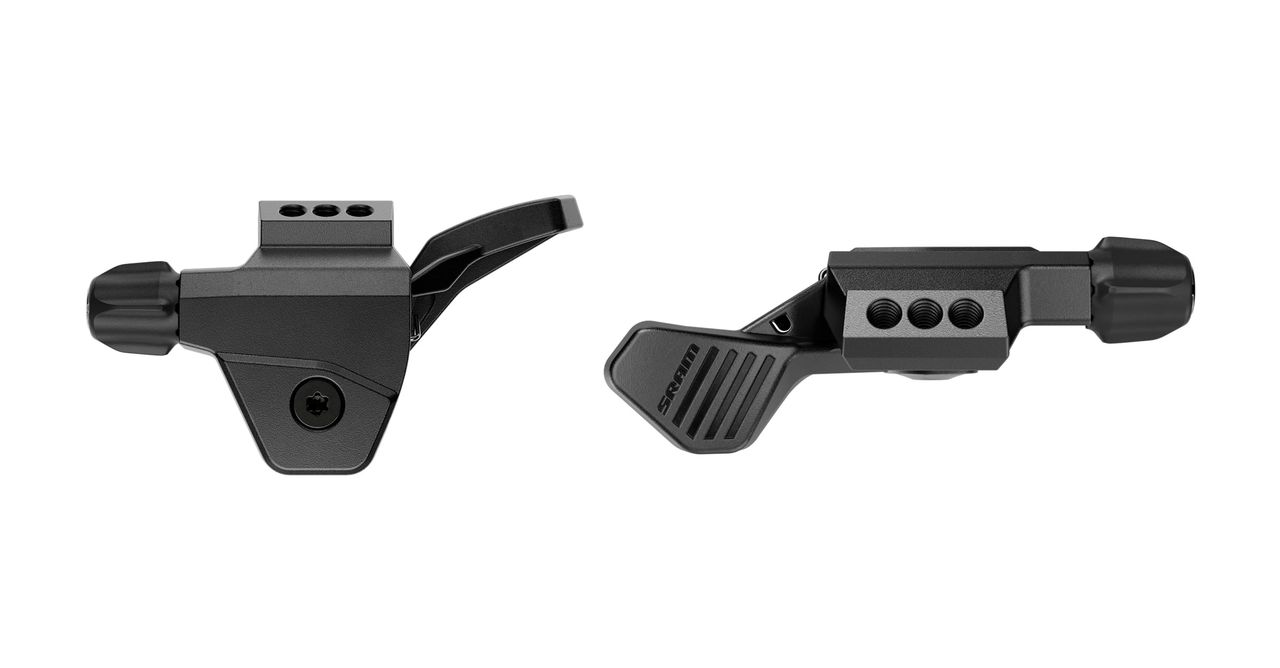
The only evidence I have today is SRAM’s new dropper post remote*. There are piles of fantastic remotes on the aftermarket (9point8, Wolf Tooth, PNW, BikeYoke, Hope, etc) so I can’t imagine SRAM jumping in to make one if not for OE purposes.
I never liked the old hydraulic Reverb, even though the later ones were very reliable. And that came down to the hydraulic actuation. Swap in a WTC ReMote Sustain or BikeYoke DeHy and suddenly, all-in-costs and service costs aside, it was one of the nicer performing uppy-downy posts on the market.
I assume more than a few SRAM employees have ridden the Reverb sans hydraulic remote and loved it. And, that this transition has been in the cards for ages. A first-gen AXSverb based on the original hydraulic Reverb. A next-gen cable Reverb based on the new all-air AXSverb.
*{Well, that and the fact the fresh AXSverb looks to be clearly designed to convert from using a battery at the middle to a cable actuator at the bottom.}

{Above images – and more interesting information – in the SRAM Reverb AXS B1 service manual.}
So, assuming a new cable-actuated Reverb is coming, who benefits? Well, first and foremost folks buying bikes that come spec with one. The new post is going to be way simpler and more easily rebuildable, without proprietary tools. Based on early reports of the AXSverb the new Cableverb should perform very well to boot.
And I’d expect a massive reversal in the waning numbers of non-AXS Reverbs on the shop floor. {Some} product managers love the ease of the all-SRAM-spec button. Off the top of my head both Kona and Chromag still have models with the hydraulic Reverb posts, and both are rumoured to have new rigs dropping, so OE spec-wise that’s where I’ll be keeping an eye.
Again, assuming this post is on the way, it’s the first time I can say I’ve been excited to try a Reverb, not to mention taking one apart.
Welcome to MEATengines, I hope you enjoyed this piece. If you did, please consider buying me a coffee. Any questions, concerns, or comments; feel encouraged to drop me an e-mail, or join us at r/MEATengines.